
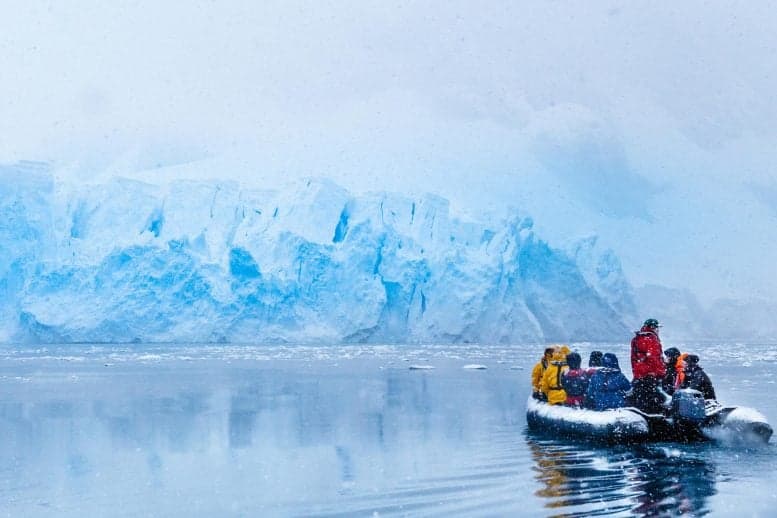
Antarctic guides walked away from their dream jobs after tourism’s environmental damage became impossible to ignore.
“You’d see massive glacier calvings, and you’d just want to cry. But all the guests would be cheering. And you’d be like … ‘Can you not put two and two together?’”
Those are the words of a former Antarctic tour guide we interviewed. For anyone interested in nature, few jobs sound more enviable. You spend months among penguins, orcas, and glaciers, helping visitors experience one of the world’s most extraordinary and unspoiled places.
But for some guides, like those we quote in this article, that privilege slowly became impossible to reconcile with their beliefs. Watching climate change unfold while helping thousands more visitors reach the continent eventually led them to leave the jobs they’d once dreamed of.
Antarctica’s Tourism Paradox
Antarctic tourism is growing fast, with over 120,000 visits in 2025-26 and up to 450,000 expected each summer within a decade. Our new study reveals how Antarctic tour guides grapple with the dilemma at the heart of their work—bringing more and more people to an ecologically vulnerable area and helping cause some of the greatest CO2 emissions of any form of tourism.
“I was down there on the hottest day ever recorded in 2020. Hiking up a glacier in my T-shirt, driving boats without gloves. It was really sad. The impacts of climate change absolutely hit you in the face.”
We interviewed 25 former Antarctic guides who decided to quit their jobs (all quotes are anonymized). These guides couldn’t align their morals with the effects of tourism they were witnessing day after day.
As Antarctic tourism expands, former guides describe a growing conflict between introducing visitors to the continent and contributing to pressures on its fragile ecosystems.
“Very often, for long periods of time, the penguins had maybe a few hours’ break during the night. Otherwise, there were hundreds of people walking through the colonies non-stop.”
While tour operators often argue that visiting Antarctica can heighten tourists’ awareness of environmental issues, former guides were struck by guests’ ignorance of human impacts.
A Growing Moral Conflict
None of the guides quit overnight. Their decisions emerged through years of reflection, uncertainty, and moral conflict.
“We are always in conflict in our minds with two parts: the excitement to go to Antarctica to work in remote places we like and being complicit in tourism industry development.”
“I can’t work in the farce of climate change cruise tourism anymore. It’s just, how can I go there, tell people about climate change, and not do anything about it?”
The Personal Cost of Leaving
The former Antarctic tour guides show meaningful change is often a painful and gradual process rather than a single dramatic moment. For many, years of acting against their values affected their wellbeing.
“I think what it comes down to for me is, you know, if I think about being on my deathbed and trying to look my kids in the eyes and saying, ‘I tried.’ I don’t know if I could have done that if I kept doing what I was doing.”
The stories of guides who left one of the world’s most extraordinary tourism jobs powerfully illustrate how abandoning unsustainable lifestyles can come with real personal costs.
“To this day, Antarctica … stays in the forefront of my head as the most incredibly raw environment that deserves all the care and protection. And I just think tourism and us being there was doing the opposite of that completely.”
Loving Antarctica From Afar
Many of the research participants still felt deeply connected to Antarctica, and they sometimes regretted leaving. Mixed feelings and ambiguity are an inherent part of decisions we take out of concern and care for others, including remote environments.
“Do I wish I was getting on a flight and heading to the floe edge to take people out on the ice? Yes, there’s a big part of me that wishes I were doing that right now. And I also know that I would feel like shit after doing it.”
Walking Away to Protect It
In the case of the people we interviewed, caring about Antarctica meant walking away from Antarctic tourism. The interviews suggest that distance doesn’t necessarily weaken responsibility. For these former tour guides, caring for Antarctica ultimately meant leaving it—and many felt better after they quit. Sometimes the best way to protect a place you love is to leave it alone.
“I was working very much against what I knew wasn’t right, and I think that was coming out in my body as well. And then when I made that decision to walk away, I just felt so much better. It was like I could breathe again.”
If you’ve ever questioned whether your work aligns with your values, these former Antarctic tour guides offer a thoughtful perspective on balancing career, well-being, and environmental responsibility. Their stories may also inspire a deeper appreciation for protecting Antarctica by leaving it untouched.
Reference: “Mind the gaps: The moral journey of tour guides who quit” by Zdenka Sokolíčková, Elizabeth Cooper and Christy Hehir, 8 July 2026, Annals of Tourism Research. DOI: 10.1016/j.annals.2026.104237




Comments
No comments yet
Be the first to share your thoughts and start the conversation!